
📑 On this page
Have you noticed your laptop becoming unusually hot, shutting down unexpectedly, or the fan constantly running at high speeds? These signs typically point toward issues with your laptop's cooling system, particularly the fan. Proper laptop fan cleaning and maintenance is crucial, not only to ensure the smooth operation of your device but also to prolong its lifespan and prevent costly hardware damage. At Esmond Service Centre, our dedicated team has over 16 years of experience specializing in laptop servicing in Singapore. We've assisted countless clients in resolving overheating issues through expert laptop fan cleaning and maintenance, providing transparent, professional solutions that effectively enhance device performance and reliability.
Signs Your Laptop Fan Needs Cleaning
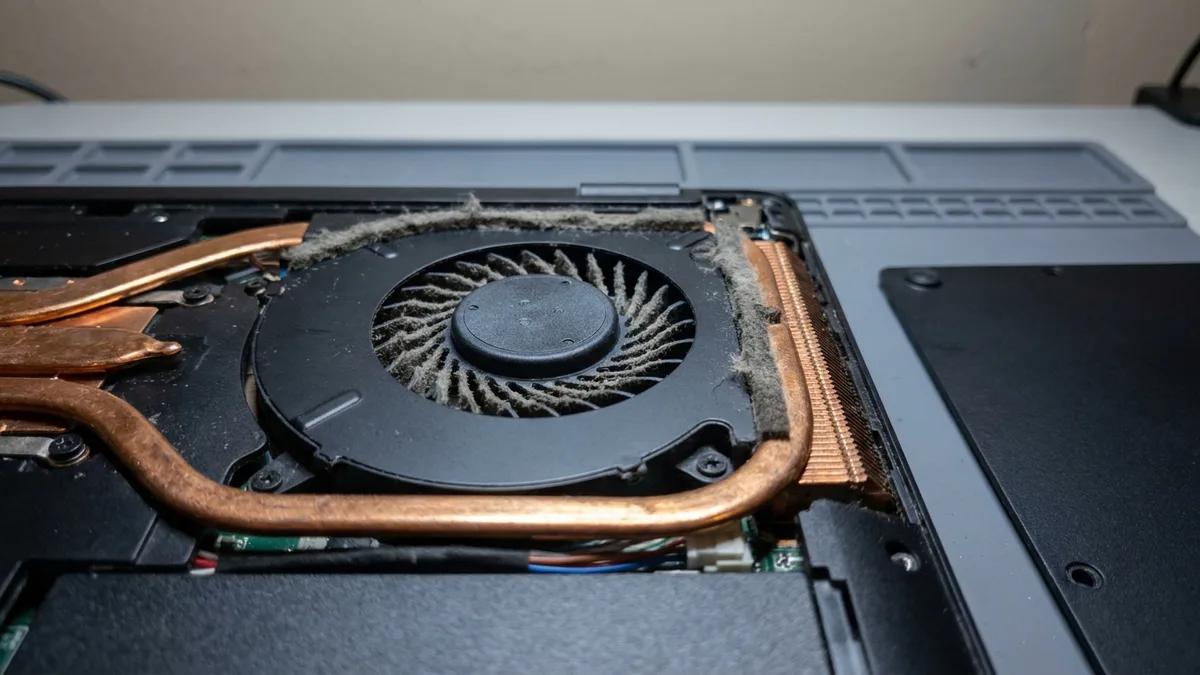
A well-functioning laptop fan efficiently dissipates heat generated by internal components. However, over time, dust and debris accumulation can significantly reduce fan effectiveness.
How to Identify:
- Excessive heat during regular tasks
- Loud or unusual fan noises
- Frequent unexpected shutdowns
- Sudden, unexplained slowness. Dell calls this thermal throttling — "a safety feature that kicks in when your computer's temperatures get too high. It reduces performance to prevent overheating and protect your hardware." A laptop that has become sluggish with no change in what you run is often a cooling problem wearing a performance mask.
Practical Guidance:
Regularly inspect your laptop for these symptoms. Observing these signs early helps prevent severe overheating and potential hardware damage.
Why It Works: Recognizing these early indicators allows for timely cleaning, reducing the likelihood of component damage and expensive repairs.
Before You Open Anything: Is It Even the Laptop Fan?
A fan that runs hard is doing its job. Before you reach for a screwdriver, rule out the things that look exactly like a dirty fan and cost minutes rather than an afternoon. Dell is blunt about the first of them: if the machine is not shutting down and the fan passes its diagnostic, a fan that runs constantly "can usually be traced to a heavy workload causing high CPU usage."
- Check what is actually running. On Windows, press Ctrl + Shift + Esc to open Task Manager and sort the Processes tab by CPU. On a Mac, open Activity Monitor and sort by % CPU. If one process sits at 80–100% with nothing demanding open, that is your fan noise, and quitting it fixes the problem in seconds. Apple's own advice for a hot Mac laptop is to "use Activity Monitor to check CPU activity" and look for "malfunctioning processes that can put a significant load on the CPU."
- Check that your laptop has a fan at all. Not every laptop does. Apple sells the MacBook Air on exactly that point — "all with a silent, fanless design" — and Apple's own support page is written conditionally throughout: "if your Mac laptop has fans", "if your Mac laptop has ventilation openings". ASUS says the same of some of its own models, whose heat "is radiated by the case" instead. If yours has no vents and has never made a sound, there is nothing inside to clean, and the fixes are the placement and workload ones below.
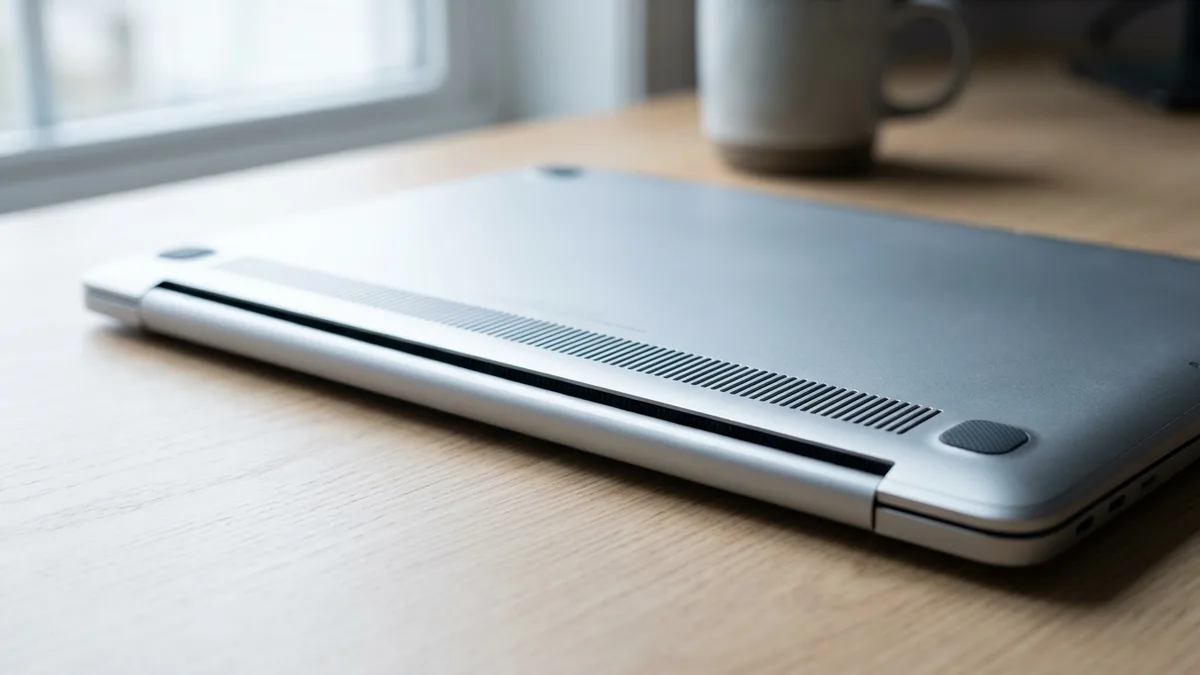
- Check that the vents are not simply covered. Find where the air actually goes in and out — usually the underside and one edge, though ASUS notes that on some models the vent hides "at the pivoting part of the laptop" rather than on the sides. A cushion, a duvet or a lap blocks it instantly. Dell's caution is specific: on "a mattress or other soft surfaces, the air vents may be blocked by the fabric, and leaving it there for an extended period leads to overheating issues quickly."
- Use the maker's diagnostic, not a temperature app. Dell's SupportAssist has a dedicated fan test; Apple is unusually direct about the alternative — "never use third-party apps to diagnose possible hardware issues." A number from a third-party monitor is not evidence that a fan has failed.
Why It Works: Two of the commonest causes of a hot, loud laptop are outside the case, and both are free to rule out in under five minutes. Opening a machine that did not need opening is how a working laptop acquires a stripped screw, a torn ribbon cable or a static fault — and if the fan is roaring because of a runaway process, the cleanest fan in Singapore will not quieten it.
Step-by-Step Guide to Laptop Fan Cleaning
Properly cleaning your laptop fan can significantly improve performance and reduce overheating.
Step-by-Step Instructions:
- Power Off and Disconnect: Completely shut down the laptop and unplug all cables.
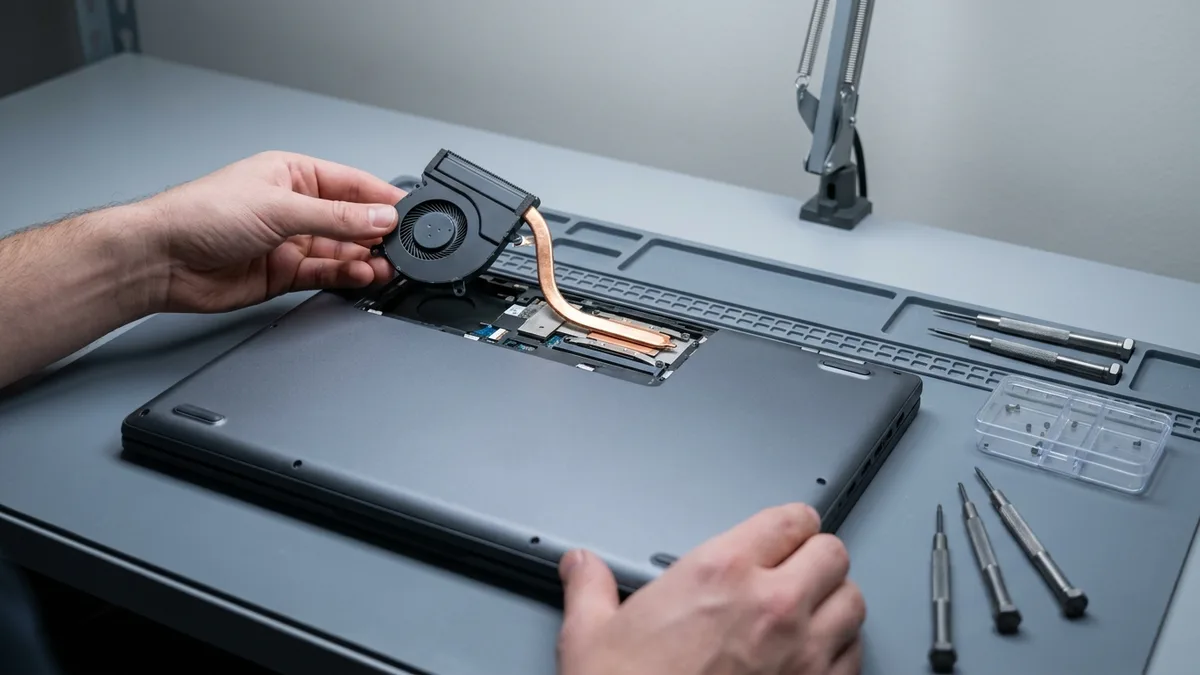
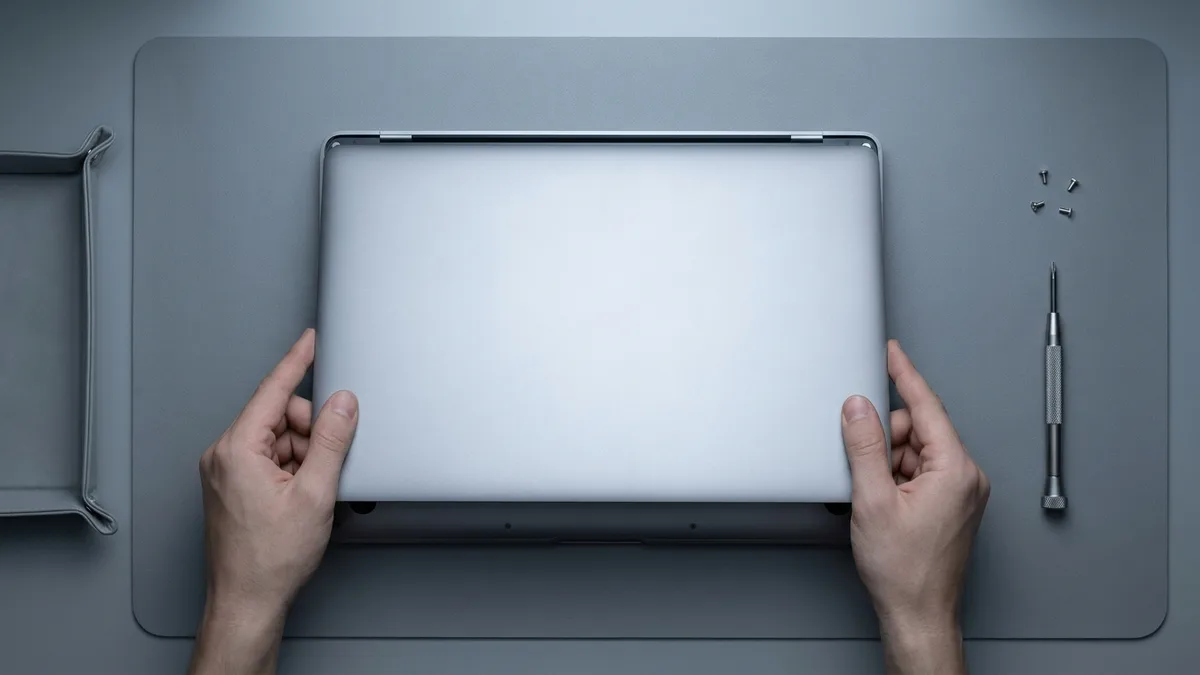
- Open Laptop Case: Carefully unscrew and remove the bottom panel following your laptop’s manual.
- Disconnect the Battery and Ground Yourself: Modern laptops have a built-in battery, so shutting down is not enough — once the panel is off, gently unplug the battery connector from the motherboard before touching the fan or heat sink, and reconnect it last. Work on a hard, non-carpeted surface and, as iFixit advises, "discharge yourself by touching a metal fixture" (or wear a grounded anti-static wrist strap) — ESD damage "is difficult to trace and diagnose, so it's better to prevent it in the first place."
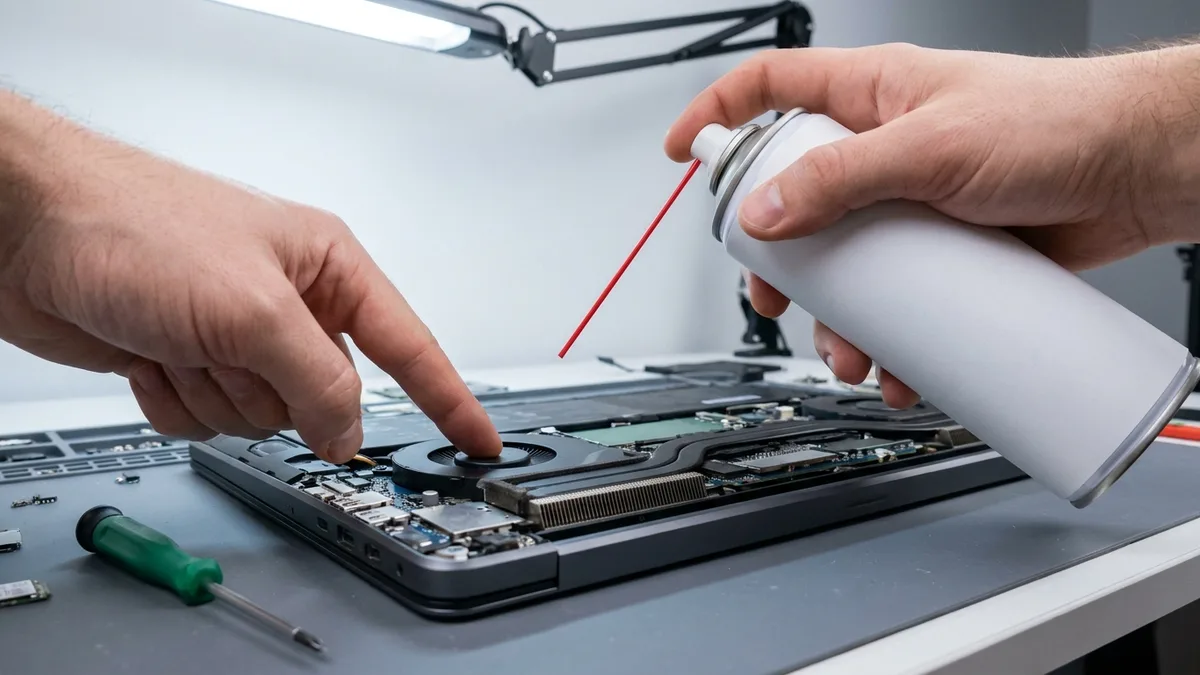
- Clean Fan and Vents: Before you spray, hold the fan blades still with a fingertip or a soft plastic pick so the fan cannot free-spin — iFixit says to "prevent the fan blades from moving while the high-pressure air is striking them," because over-spinning can wear the bearing and warp the blades. Keep the nozzle 10–15 cm back and use short bursts. ASUS warns that "exposure to strong air blasted from a short distance may damage the fan blade," and tells owners not to clean the interior with "devices that utilize strong airflow ... such as air boost compressor," a method it says "has been observed to damage laptop fans." Hold the can upright — Dell's reason is "to avoid moisture buildup" — and never tilt or invert it, or it sprays freezing liquid propellant onto the electronics. Use proper canned air or an electronics duster, never a petrol-station or workshop air hose, whose "air ... often contains water or oil from the compressor."
- Never Reach for the Vacuum Cleaner: it is the tool most households already own and it is the one to leave in the cupboard. Dell answers it directly — "Can I use a vacuum cleaner to clean my Dell's vents? No — vacuum cleaners can generate static electricity, which might damage internal components. Use compressed air instead." ASUS gives the same warning for its dust filters: "do not use a vacuum cleaner, as this can harm critical components of the laptop." The static you cannot feel is the static that kills a board, which is the entire reason for the grounding step above.
- Manual Cleaning (Optional): If accessible, hold each blade steady and wipe it gently with a lint-free cloth or cotton swab lightly dampened with high-strength (90%+) isopropyl alcohol — support the blade so you are not spinning or bending it, and let it dry fully before reassembly.
- Reassemble: Replace and secure the bottom panel correctly.
Why It Works: Removing dust ensures unimpeded airflow, directly reducing overheating and improving the fan’s cooling efficiency.
Why Regular Laptop Fan Maintenance Matters
Regular fan maintenance goes beyond occasional cleaning; it includes proactive measures like scheduled cleaning and periodic checks.
Practical Maintenance Tips:
- Schedule cleaning every 6–12 months, and read the Singapore section below before you settle on a number.
- Clean out dust only — do not oil the fan. Modern laptop fans use sealed bearings that are not meant to be user-lubricated; a fan that stays noisy after cleaning usually has a worn bearing that should be replaced or professionally serviced.
- Check the fan with the manufacturer's own diagnostic rather than a third-party temperature app — Dell's SupportAssist includes a fan test, and Apple states plainly: "never use third-party apps to diagnose possible hardware issues."
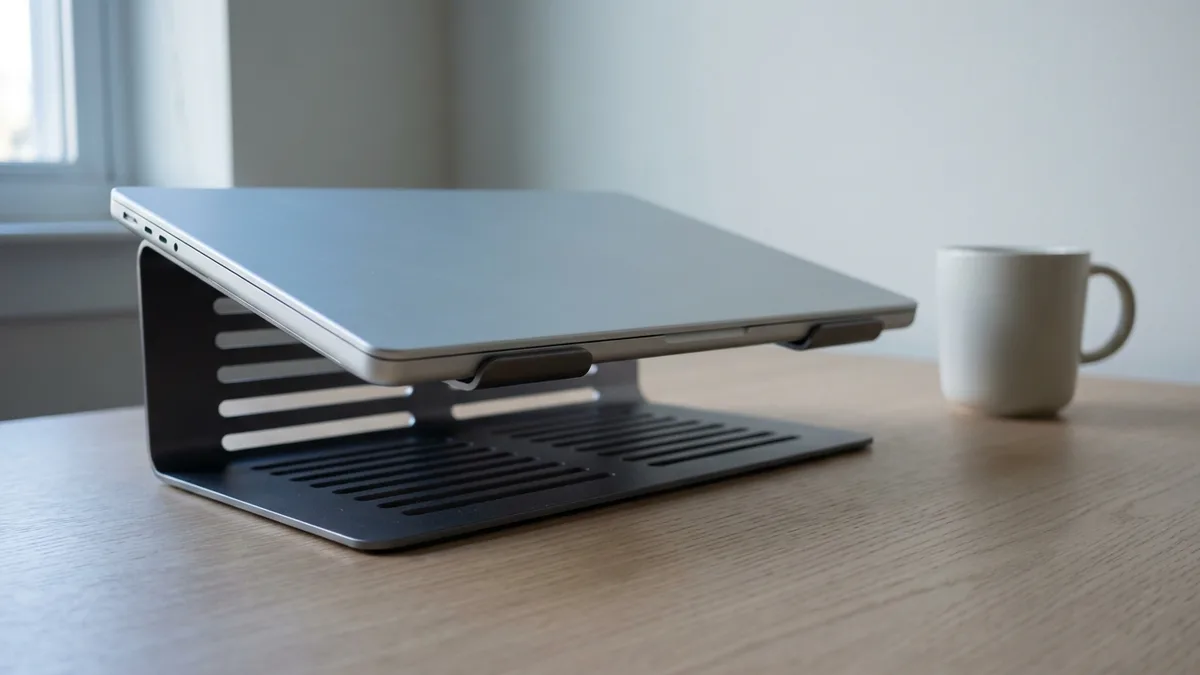
- Keep the vents clear — this prevents more overheating than cleaning ever cures. Use the laptop on a hard, flat surface. Dell: "placing your laptop on soft surfaces like beds or couches can block vents. Always use your laptop on a hard, flat surface." Apple is blunter still: "don't use your Mac laptop in your bed, on a pillow or under bedding."
- A cooling pad is a legitimate fix, not a gimmick. Dell's own answer is "yes, cooling pads enhance airflow and help reduce heat during prolonged use."
- Mind the room, not just the machine. Apple specifies an operating range of 10° to 35°C for a MacBook Air and singles out parked cars, where "temperatures ... can exceed this range."
Why It Works: Scheduled maintenance significantly reduces the risk of overheating issues, ensuring components remain cool and operating efficiently, ultimately prolonging your laptop’s lifespan.
How Singapore's Climate Changes How Often You Should Clean
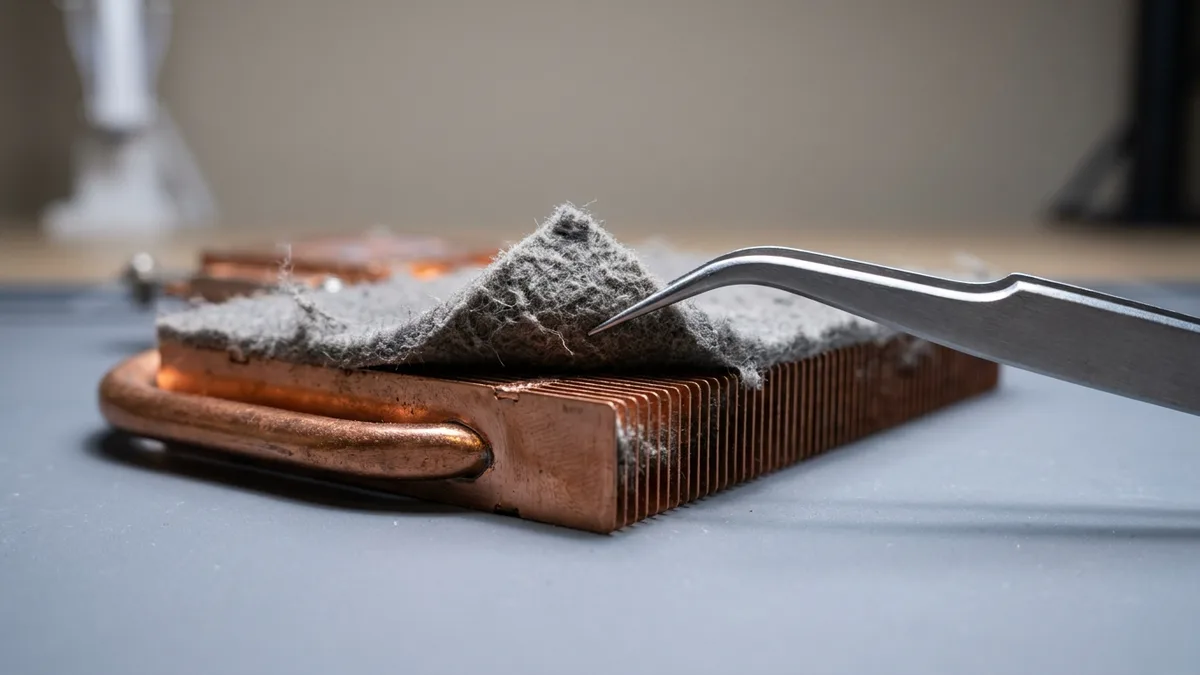
Almost every guide says "every 6–12 months" and almost none says what should move the number. In Singapore, something should. The Meteorological Service Singapore's 1991–2020 climate record puts the mean daily maximum relative humidity between 93.0% and 96.5% in every single month of the year, with a mean annual figure of about 82%. Set that against what a manufacturer thinks worth printing: Apple's published specification for a MacBook Air is a relative humidity of 0% to 90%, non-condensing — while Apple's own support page for the same machines gives 0% to 95%. We are naming that disagreement rather than quietly picking the more convenient side. Either way, the ambient humidity here sits at or above the ceiling Apple states.
What follows is a rule of thumb rather than a law, and it is worth saying plainly. If the machine lives on a desk in an air-conditioned room and rarely travels, the 12-month end of the range is reasonable. If it travels, gets used on a bed or a sofa, or shares a home with pets or cigarette smoke — ASUS notes that smoke residue on fan blades and heat sinks is "oily" and "can easily attract and absorb dust and hair" — plan on six. And if the fan is loud again three months after a proper clean, that is not dust coming back: it is usually a worn bearing, and no amount of cleaning fixes one.
When Thermal Paste Replacement Is Worth It
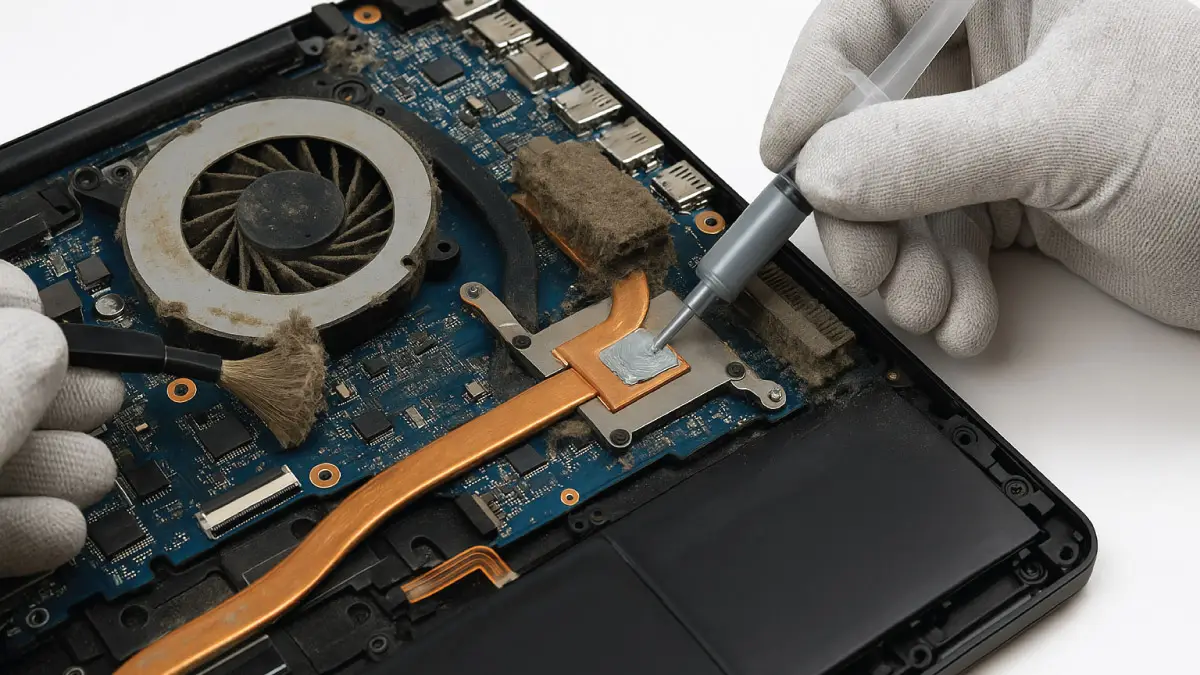
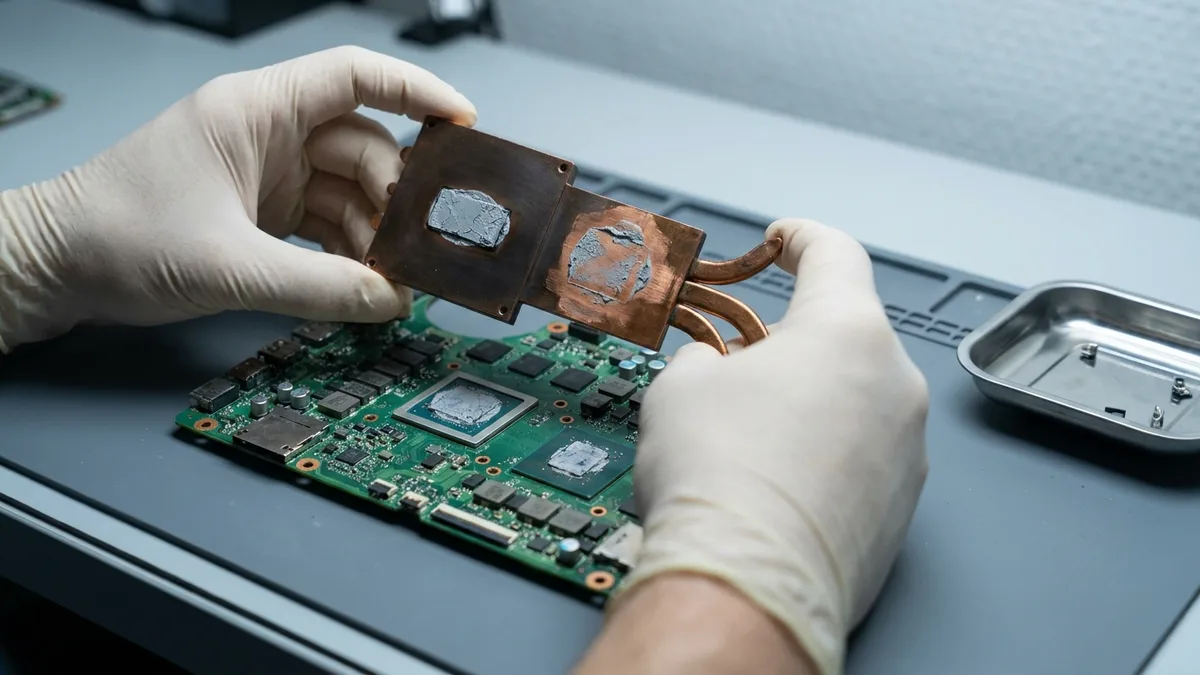
Thermal paste plays a critical role in laptop cooling by facilitating efficient heat transfer from the CPU and GPU to the heat sink.
How to Replace Thermal Paste:
- Remove the Heat Sink — Follow the Numbers, Not a Pattern: a laptop heat sink carries its own screw sequence stamped into the metal, and the manufacturer's manual tells you to obey it. Dell's XPS 17 service manual reads: "in reverse sequential order (as indicated by the numbers on the heat sink), remove the four screws." Loosen a little at a time so the pressure comes off evenly, then lift. If old paste has glued it down, gently twist it free rather than prying — forcing it can crack the bare CPU or GPU die. Dell adds two cautions worth repeating: let it cool first, because "the heat sink may become hot during normal operation", and do not touch the heat-transfer surfaces, because "the oils in your skin can reduce the heat transfer capability of the thermal grease."
- Clean Off the Old Paste: Use high-strength (90%+, ideally 99%) isopropyl alcohol with a lint-free cloth, coffee filter, or non-shedding paper towel to remove the old paste completely, and — as Intel notes — "let it dry before continuing."
- Apply New Paste: Apply only a small amount — about a grain of rice on each bare die (a laptop usually has a CPU die, and on many models a separate GPU die). A laptop die is much smaller than a desktop chip, so a pea is too much: as Intel warns, excess paste "risks spilling out onto the motherboard." Use a non-conductive paste and never over-apply.
- Reattach the Heat Sink — In the Printed Order: align it carefully first; Dell warns that "incorrect alignment of the heat sink can damage the system board and the processor." Then tighten in the sequence the stamped numbers give, which is the reverse of the order you released them in — Dell's install step is "in sequential order (as indicated by the numbers on the heat sink), replace the four screws." Intel's principle is the reason that sequence exists and still applies: turn "each a few times before moving on to the next" so the pressure stays even and the die is not cracked. Intel's "diagonal pattern ... as if you were drawing an X" is written for a desktop cooler with four corner screws; on a laptop the manufacturer has already worked the order out and printed it on the part.
Why It Works: Replacing dried-out thermal paste restores optimal heat transfer, significantly reducing CPU temperatures and improving overall performance.
When Should You Seek Professional Laptop Fan Cleaning in Singapore?
While basic laptop fan cleaning and maintenance can be performed at home, certain situations require professional attention — that is when our laptop overheating & fan cleaning service can help.
Scenarios Requiring Professional Service:
- Persistent overheating despite regular cleaning
- Loud grinding or clicking noises from the fan
- Physical damage to fan blades or components
Benefits of Professional Servicing:
- Comprehensive diagnostics and precise problem identification
- Safe and thorough cleaning and maintenance
- A 3-month warranty on the fan and thermal work, extendable to 1 year via the Esmond Care Plan
Why It Works: Professional technicians at Esmond Service Centre possess the expertise, tools, and experience necessary to perform complex repairs safely and efficiently, ensuring maximum laptop performance and reliability.
Essential Laptop Fan Cleaning and Maintenance Tips for Improved Performance
Regular laptop fan cleaning and maintenance significantly reduces overheating risks, extends hardware lifespan, and enhances overall device performance. By recognizing overheating symptoms early, performing regular cleanings, and understanding when to seek professional help, you ensure your laptop remains reliable and efficient. Have a question about your laptop's cooling? Message us on our social channels or bring it in for a free diagnostic — our technicians are glad to help. For more insights and expert advice, stay connected and informed about keeping your technology running smoothly.
Need Expert Laptop Fan Cleaning and Maintenance? Contact Us Today!
Enjoyed this comprehensive laptop fan cleaning and maintenance resource? Follow our Facebook page, LinkedIn profile or Instagram account for more expert insights and practical tips on cutting-edge technology. Experiencing persistent overheating or fan issues? Contact Esmond Service Centre now for professional consultation and trusted servicing in Singapore. Keep your laptop cool, efficient, and performing at its best.

Esmond Service Centre's experienced technicians can diagnose and fix it fast — free diagnostics, repairs from $65.