
📑 On this page
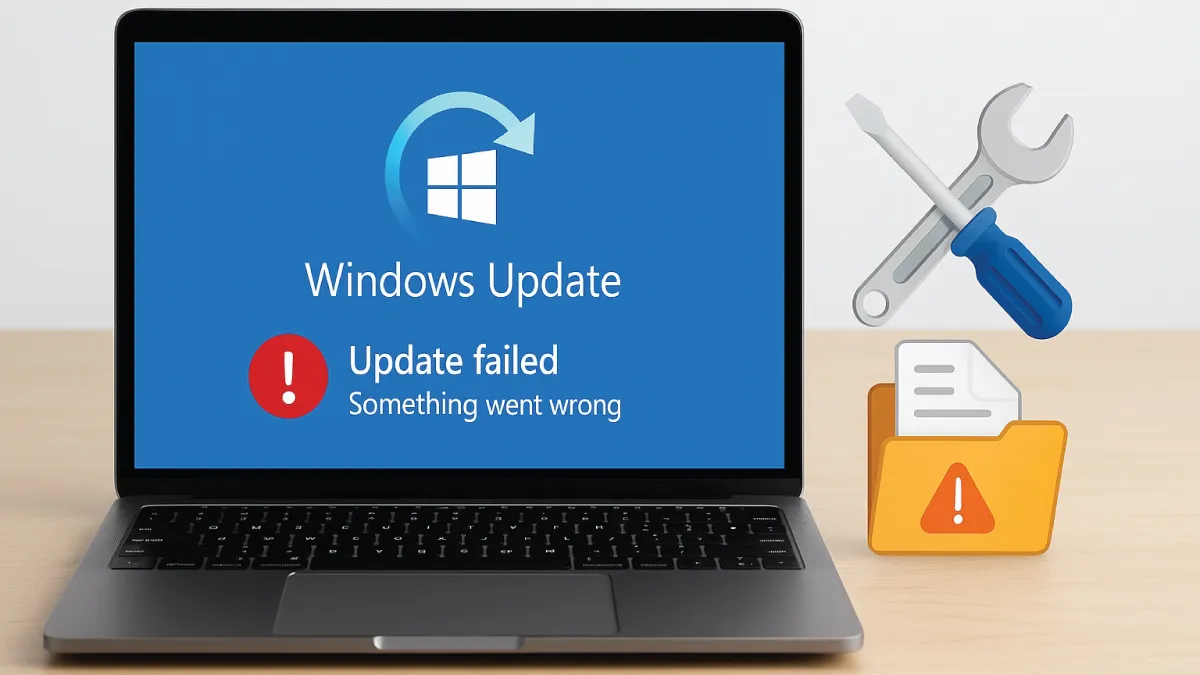
One of the most frustrating situations for any PC user is when a routine update wreaks havoc on your computer. If you’ve found yourself thinking, “Help, a Windows update broke my PC!”, you’re not alone. As an IT technician at Esmond Service Centre, I have seen many cases where a Windows update caused crashes or even made PCs unbootable. The good news is that most of these problems can be fixed. In this guide, I’ll share proven, step-by-step solutions we use to help our customers recover their systems after a bad update. You’ll learn why each fix works and how to safely apply it, so you can get your PC running smoothly again.
Which Problem Do You Actually Have?
Three different faults arrive wearing the same sentence, and only one of them belongs on this page. Two minutes spent here will save you from following steps that cannot reach your machine.
No lights, no fans, no logo — nothing at all
The screen never lights and nothing happens when you press power. That is a power or hardware fault, and the update is probably a coincidence rather than a cause. None of the steps below can reach it, because they all need the PC to at least start. Our guide for that machine is laptop won't turn on after a Windows update.Windows still starts — even only in Safe Mode
You reach a desktop, a sign-in screen, or Safe Mode. You do not need the Recovery Environment and you do not need a single forced shutdown. Uninstall the update from Settings, which is the first step in the next section. This is much the safest position to be in, because nothing has to be done blind.The PC powers on but Windows never finishes starting
A logo that never moves, a spinner that never stops, a black screen, or a repair loop. This is the page you want — start at the next section, and note that Windows may open the Recovery Environment for you before you get there.It has already restarted into a recovery screen by itself
On Windows 11 version 24H2 (build 26100.4700 or later) Microsoft ships quick machine recovery, which it describes as using “a secure and connected Windows Recovery Environment (WinRE) to scan Windows Update for remediation options” after repeated boot failures. Microsoft says cloud remediation is “enabled by default” on Windows Home, and on Windows Pro devices that are not domain joined or managed by an organisation. If that is what you are looking at, leave the PC connected to the internet and let it finish before you touch anything else. It is not available on Windows 10 or on earlier Windows 11 builds.

How Do I Uninstall the Update That Broke My PC via Recovery Mode?
Sometimes the quickest fix is to simply remove the update that caused the issue, effectively rolling back the changes that might have broken the PC. Faulty or incompatible Windows updates can cripple your system. By uninstalling the latest update, you essentially undo the recent changes.
Solution – Remove the latest Windows update using Windows Recovery Environment (WinRE):
If Windows still starts, do it from Settings
This is Microsoft's own route and it risks nothing: Start > Settings > Windows Update, then under More options choose Update history, and under Related settings choose Uninstall updates. Select the update and choose Uninstall. On Windows 10 the path is Settings > Update & Security > Windows Update > View your update history > Uninstall updates. Write down the KB number beside the update before you remove it — it is the only way to recognise the same patch if Windows offers it again.If Windows will not start, let two start attempts fail
Microsoft's Recovery Environment opens by itself after “two consecutive failed attempts to start Windows” or “two consecutive unexpected shutdowns that occur within two minutes of boot completion”. So interrupt the start twice — hold the power button until the machine dies as the logo appears — and then let the third start run. Some guides say to force it off three times; the third interruption cuts short the very boot that was about to give you the recovery menu, and it is one more hard power-off on a machine that is already unhappy.Uninstall the update from the Recovery Environment
Choose Troubleshoot > Advanced options > Uninstall Updates, then Uninstall latest quality update for an ordinary monthly patch, or Uninstall latest feature update for a version upgrade. Enter your administrator password if you are asked for it. Microsoft notes that “You can run most tools within WinRE without selecting an administrator account and entering the password”, but that if you open the Advanced startup menu from inside Windows and select a WinRE tool, you “must provide the user name and password of a local user account with administrator rights” — so know that password before you start.Restart and check
Restart normally. If the PC boots, pause updates for a week or two in your Windows Update settings rather than letting Windows offer the same patch straight back, and check the manufacturer's support page for a newer driver in the meantime.
Why this works: Removing the bad update undoes the last change to Windows – it’s like hitting “undo” on the update. If a Windows update broke my PC due to a bug or conflict, rolling back that update restores your system to its previous stable state. In short, rolling back a bad update often fixes the “Windows update broke my PC” problem immediately.
What this will not fix, and the three limits Microsoft publishes. Removing an update cannot help if the fault is hardware, and it does not undo a driver the update replaced — that is a separate rollback in Device Manager. Beyond that, Microsoft publishes three limits that most guides leave out. ① “Some updates cannot be uninstalled” — the option simply will not be offered for those. ② Rolling back a whole Windows version is time-limited: Microsoft says that option “is only available for a limited time after upgrading. In most cases, you have 10 days to go back”, and that ten days after the upgrade your previous version of Windows “is automatically deleted from your PC”. ③ Removing a security update is not free — Microsoft's own instruction is to “make sure you understand the risks” first, because you are re-opening whatever that patch closed. Treat it as a temporary measure and reinstall the update once a fixed version ships.

Run Startup Repair and Fix Corrupted Files
If uninstalling the update doesn’t resolve the issue, the next step is to use Windows’ built-in repair tools to fix any system files or boot records the update may have damaged. These tools can address many problems behind “Windows update broke my PC” cases.
Solution – Use Windows Startup Repair and System File Checker (SFC):
Run Startup Repair
From the Recovery Environment choose Troubleshoot > Advanced options > Startup Repair. It targets the files and records that let Windows start, so it is quick and it is worth doing before the file-repair tools below. Microsoft notes that when Startup Repair launches automatically after boot failures it “only executes operating system and driver file repairs, provided that the boot logs or any available crash dump point to a specific corrupted file” — so it is narrower than it sounds, and a clean result does not mean nothing is wrong.Run DISM first — the order is not a preference
Microsoft's instruction is explicit: “Step 1: Run DISM … You should run DISM prior to running the System File Checker”, and the reason is mechanical rather than stylistic — “DISM provides the files required to repair your corrupted files.” Run the System File Checker first on a PC whose component store is itself damaged and it has no good copies to restore from, so it reports a failure and you conclude the tool is broken. From a running Windows (Safe Mode with Networking counts), open an Administrator Command Prompt and runDISM /Online /Cleanup-Image /RestoreHealth. It needs an internet connection, because that is where it fetches replacement files from.In the Recovery Environment, both commands need extra switches
This is where almost every guide goes wrong, and it matters because the Recovery Environment is its own small copy of Windows running from driveX:. A baresfc /scannowand a/OnlineDISM examine that, not the Windows you are trying to repair. Microsoft's rule is “if you're servicing a running computer, use the /Online option. If you're servicing a mounted or applied image, specify /Image:<path_to_image>”, and it documents SFC's offline switches as/offbootdirand/offwindir, “for offline repair”. So from the recovery Command Prompt the commands areDISM /Image:D:\ /Cleanup-Image /RestoreHealthandsfc /scannow /offbootdir=D:\ /offwindir=D:\Windows. The drive letters move in here — your Windows drive is usuallyD:rather thanC:, which is why Microsoft's own example uses D. Check withdir D:\Windowsfirst and use whichever letter answers.Reboot and test
Restart normally once both tools have finished. If the System File Checker returns “Windows Resource Protection could not perform the requested operation”, Microsoft's remedy is to run the scan “in safe mode” and to make sure “the PendingDeletes and PendingRenames folders exist under %WinDir%\WinSxS\Temp”.
Why this works: Startup Repair fixes many issues that can prevent Windows from starting. SFC restores the integrity of Windows system files. Many “Windows update broke my PC” cases are caused by corrupted files or settings. Repairing those removes the cause of crashes so your PC can start normally again. Note: In some cases, you may also need to boot into Safe Mode and uninstall a faulty driver or software introduced by the update (these can also cause "Windows update broke my PC" situations).
What this will not fix. These two tools repair Windows' own files. They will not remove the bad update, they will not recover a deleted document, and they will not repair a failing drive — if anything, a drive that is on its way out gets worse the longer it is asked to read and write. If Startup Repair, DISM and SFC all report success and the PC still will not boot, that is a strong sign the problem is not a corrupted file at all, and running them a second time will not change the answer.

How Do I Use System Restore to Undo a Broken Windows Update?
System Restore can rescue your PC by reverting system files and settings to a previous snapshot (restore point) from before the update. Windows often creates a restore point during major updates, so using it essentially lets you “rewind” your PC to a stable state.
Solution – Roll back Windows to a pre-update state:
Launch System Restore
In the Advanced options recovery menu, select System Restore. The PC will reboot and open the System Restore wizard.Choose a restore point
Pick a restore point from before the problematic update. For example, if you’re thinking “a Windows update broke my PC” after a recent patch, choose a restore point dated before that update was installed. Start the restoration and confirm any prompts.Let it restore and reboot
Wait for the restore process to complete and allow the PC to restart. Once it reboots, log in and see if the issue is resolved. Your system will be in the state it was in before the update, effectively fixing the “Windows update broke my PC” problem. (Personal files won’t be affected, though you may need to reinstall programs or updates that were added after that restore point.)
Why this works: Reverting to a snapshot from before the bad update essentially makes it like the update never happened. All the system changes from the update are undone. This often fixes glitches from the bad update, eliminating the "Windows update broke my PC" problem.
What this will not fix. System Restore only exists if a restore point does. Windows usually creates one before a major update, but not always, and if the list is empty this route is closed rather than broken — move on rather than hunting for it. It also does not touch your documents, which sounds reassuring and cuts both ways: it will not bring back a file the update deleted. And it will not undo a firmware or BIOS update, which lives outside Windows altogether.

When Should I Stop — and What Does a Reset Really Cost?
Some guides on this subject end with “if all else fails, reset Windows”, as though that were simply the last item on a list. It is not. It is the point where the cost changes from your afternoon to your files, and it deserves to be described honestly before you reach for it.
Stop and bring the machine in if any of these is true. You cannot find the BitLocker recovery key and the PC is asking for it — going further is how a drive becomes permanently unreadable. The drive is clicking, buzzing, or has disappeared from the recovery menu's list. The PC restarts or shuts itself off partway through a repair. Startup Repair, System Restore, DISM and SFC have all been tried and Windows still will not start. Or there is anything on that drive you have not backed up somewhere else — in which case the right order is to get the data off first and repair the PC second, never the other way round.
And this is what a reset actually costs. Microsoft's “Keep my files” option preserves your documents but removes your installed programs, so you rebuild the machine afterwards. “Remove everything” is what its name says: Microsoft's own advice to anyone who has lost their recovery key is that you “have to reset your device” and that “resetting your device will remove all of your files”. And on an encrypted drive the reset is gated by the key you may not have — Microsoft's instructions for resetting from Windows RE say “If you’ve encrypted your device, you’ll need your BitLocker key to complete this task”. A reset is not the safe default at the end of a list. It is the option with the highest price on the page.
If you would rather not make that call yourself, you do not have to. Esmond Service Centre gives a genuinely free, no-obligation diagnostic at Alexandra and Sin Ming that establishes whether this is a software problem or a failing drive before any money or any reset is discussed — and if it is the drive, we can talk about data recovery while the data is still there rather than after a reset has written over it.
Restoring Your PC After a Broken Windows Update: Key Takeaways
Recovering from a bad Windows update can be nerve-wracking, but with the right approach it’s doable. Here are the key takeaways for when a Windows update broke my PC:
- Stay calm and methodical: Begin with simple fixes like uninstalling the recent update. Often, reversing that one change will immediately solve the problem.
- Use Windows’ recovery tools: Features like Startup Repair and System Restore are built to deal with situations where updates or other changes go wrong. They can automatically fix or undo problematic changes.
- Troubleshoot step-by-step: Address one potential issue at a time (update rollback, then repair, then restore point, etc.). This structured approach helps identify the culprit and minimizes risk to your data.
- Know what a reset costs before you agree to one: “Keep my files” removes your installed programs, “Remove everything” removes your files, and on an encrypted drive Windows will ask for a recovery key you may not have. It is the most expensive option on this page, not the tidy last step.
- Prepare for next time: keep a backup of anything you would miss, save your BitLocker recovery key somewhere that is not the encrypted PC, and pause non-critical updates for a week or two so you are not among the first to install a patch that turns out to be faulty.
Follow this guide in order and you should be able to resolve most update-related problems yourself, and — just as importantly — recognise the point at which carrying on costs more than it saves. If your PC is still not starting, or it is asking for a recovery key you do not have, bring it to Esmond Service Centre at Alexandra or Sin Ming. The diagnosis is free, and it is far cheaper to ask before a reset than after one.
Get Professional Help and Stay Updated
Enjoyed this comprehensive troubleshooting guide? Follow our Facebook page, LinkedIn profile or Instagram account for more expert insights and practical tips on cutting-edge technology. We regularly share tech advice and repair tricks to keep your devices running smoothly.
If you’re still facing issues or simply want peace of mind, contact Esmond Service Centre for a professional consultation. Our experienced technicians are ready to help diagnose and fix any PC problems, whether it’s due to a Windows update or any other tech trouble. Don’t hesitate to reach out – we’re here to get your PC back on track and ensure you stay stress-free with your technology.

Esmond Service Centre's experienced technicians can diagnose and fix it fast — free diagnostics, repairs from $65.